lyogenix.com · research use only
Printed: 16/08/2026
For Research Use Only — Not for Human Consumption
This product is strictly intended for in-vitro research and laboratory use by qualified researchers. It is not approved for human or veterinary therapeutic use, self-administration, or any clinical application.
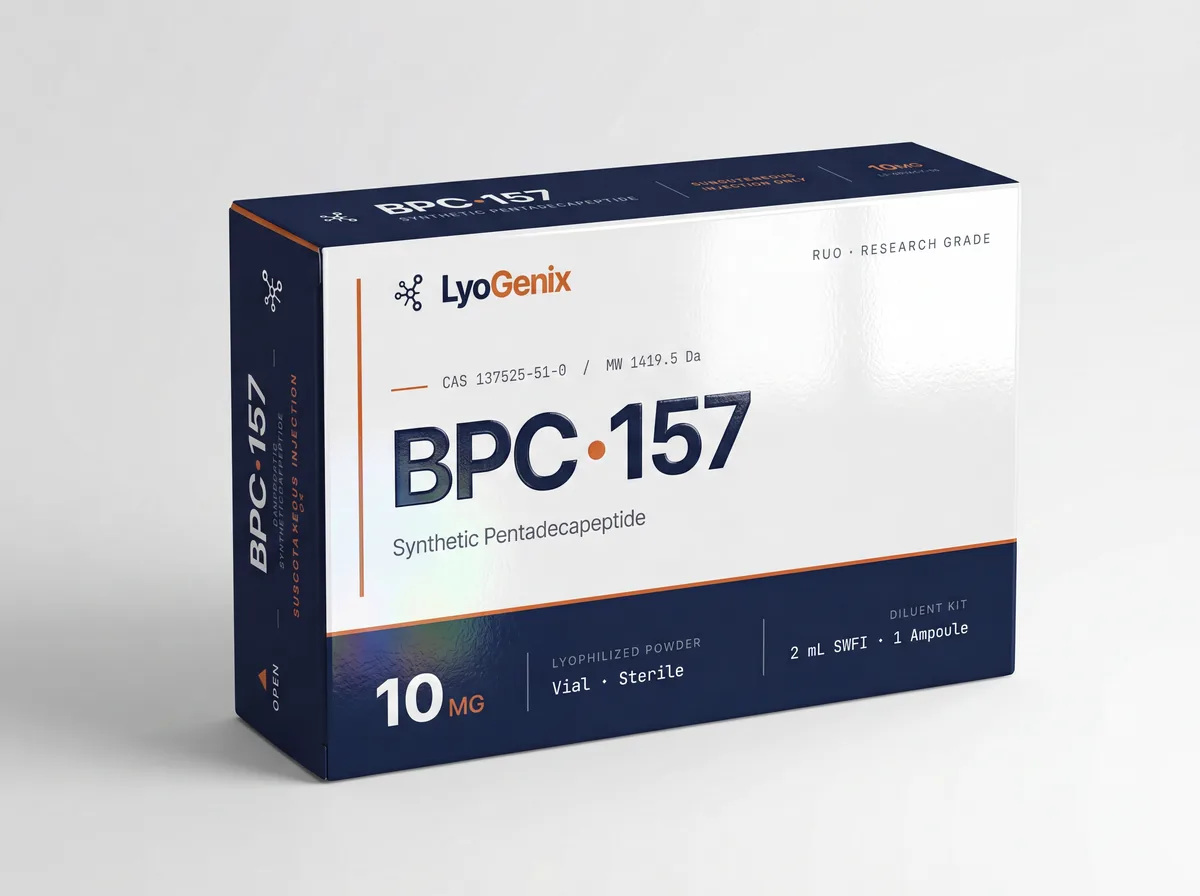
BPC-157
Synthetic Pentadecapeptide
10 mg lyophilized powder + 2 mL sterile water
Overview
BPC-157 (Body Protection Compound-157) is a synthetic pentadecapeptide derived from a protective protein found in human gastric juice. First isolated and characterized in the early 1990s, this 15-amino acid peptide has garnered significant attention in preclinical research for its remarkable cytoprotective and regenerative properties across multiple organ systems.
The peptide's discovery stemmed from research into gastric juice proteins that demonstrated protective effects on gastric mucosa. Unlike many peptides of similar size, BPC-157 exhibits notable stability in human gastric juice, maintaining its biological activity even under highly acidic conditions — a property that distinguishes it from most bioactive peptides.
Research interest in BPC-157 has expanded considerably due to its demonstrated effects in numerous animal models, showing potential in tissue repair, wound healing, and organ protection. Its mechanisms appear to involve modulation of multiple growth factors, the nitric oxide system, and various signaling pathways associated with tissue regeneration.
Chemical Profile
| Property | Details |
|---|---|
| Sequence | Gly-Glu-Pro-Pro-Pro-Gly-Lys-Pro-Ala-Asp-Asp-Ala-Gly-Leu-Val |
| Molecular Formula | C₆₂H₉₈N₁₆O₂₂ |
| Molecular Weight | 1419.53 Da |
| Purity | ≥98% (HPLC verified) |
| Form | Lyophilized Powder |
| Appearance | White to off-white powder |
| Solubility | Sterile water, saline |
| Storage | 2°C – 8°C, protect from light |
Mechanism of Action
BPC-157 exerts its biological effects through a complex interplay of multiple signaling pathways. Central to its mechanism is the modulation of the nitric oxide (NO) system, where BPC-157 has been shown to interact with both the NO synthase and NO-related pathways, contributing to its protective effects on vascular endothelium and tissue repair processes.
A key pathway involves the activation of the FAK-paxillin signaling cascade. BPC-157 promotes the phosphorylation of focal adhesion kinase (FAK) and its downstream target paxillin, which are critical regulators of cell adhesion, migration, and survival — processes essential for wound healing and tissue regeneration.
Additionally, BPC-157 upregulates several important growth factors, including epidermal growth factor (EGF), vascular endothelial growth factor (VEGF), and fibroblast growth factor 2 (FGF2). This upregulation promotes angiogenesis (formation of new blood vessels), which is crucial for tissue repair. The peptide also demonstrates cytoprotective properties by modulating the expression of genes involved in oxidative stress response and inflammatory cascades.
Research Applications
- Tissue repair and wound healing acceleration in various tissue types
- Gastrointestinal healing and mucosal protection
- Angiogenesis promotion and vascular repair
- Tendon, ligament, and muscle recovery in injury models
- Neuroprotection and peripheral nerve regeneration
- Anti-inflammatory effects through cytokine modulation
- Bone healing and fracture repair research
- Cardioprotective effects in ischemia-reperfusion models
Published Research & Literature
Sikiric P, et al. (2018) "BPC 157's effect on healing." Journal of Physiology Paris, 112(1):3-6.
Comprehensive review of BPC-157's healing effects across multiple organ systems.
Seiwerth S, et al. (2014) "BPC 157 and standard angiogenic growth factors." Life Sciences, 97(2):263-267.
Demonstrated BPC-157's interaction with key angiogenic factors EGF, VEGF, and NO system.
Chang CH, et al. (2011) "BPC-157 promotes muscle healing." Journal of Applied Physiology, 110(3):774-780.
Showed accelerated muscle healing through growth factor upregulation.
Sikiric P, et al. (2016) "Brain-gut axis and pentadecapeptide BPC 157." Current Neuropharmacology, 14(8):857-865.
Explored BPC-157's role in the brain-gut axis and neuroprotective mechanisms.
Handling & Reconstitution
- 1Allow the vial and sterile water to reach room temperature (15–25°C).
- 2Using a sterile syringe, withdraw the appropriate volume of sterile water.
- 3Inject the water slowly along the inside wall of the vial — do not spray directly onto the powder.
- 4Gently swirl the vial until the powder is fully dissolved. Do not shake vigorously.
- 5Once reconstituted, store at 2°C – 8°C. Protect from light.
- 6Use within 28 days after reconstitution.
- 7Do not freeze reconstituted solution.
Product Specifications
- 1 × Vial (2R) containing BPC-157 lyophilized powder (10 mg)
- 1 × Ampoule Sterile Water for Injection (2 mL)
- Storage: 2°C – 8°C, protect from light
- Shelf life: 24 months (unopened, properly stored)
Ingredients
Body Protection Compound-157 (10 mg), Mannitol, Sucrose
Certificate of Analysis
Full CoA with HPLC purity data and mass spectrometry confirmation is available for every batch.
Request CoARelated Products
Disclaimer
This product is intended for research and laboratory use only. Not for human consumption. LyoGenix Labs Pvt. Ltd. does not condone or promote the use of these compounds outside of legitimate research.
Authenticity Guarantee
Every LyoGenix product ships with a unique scratch code under a tamper-evident holographic label. Scratch the label to reveal your code and verify it here — confirming your product is genuine.
- Cryptographically unique code per box
- One-time verification — tracks first use
- Genuine LyoGenix Labs guarantee